
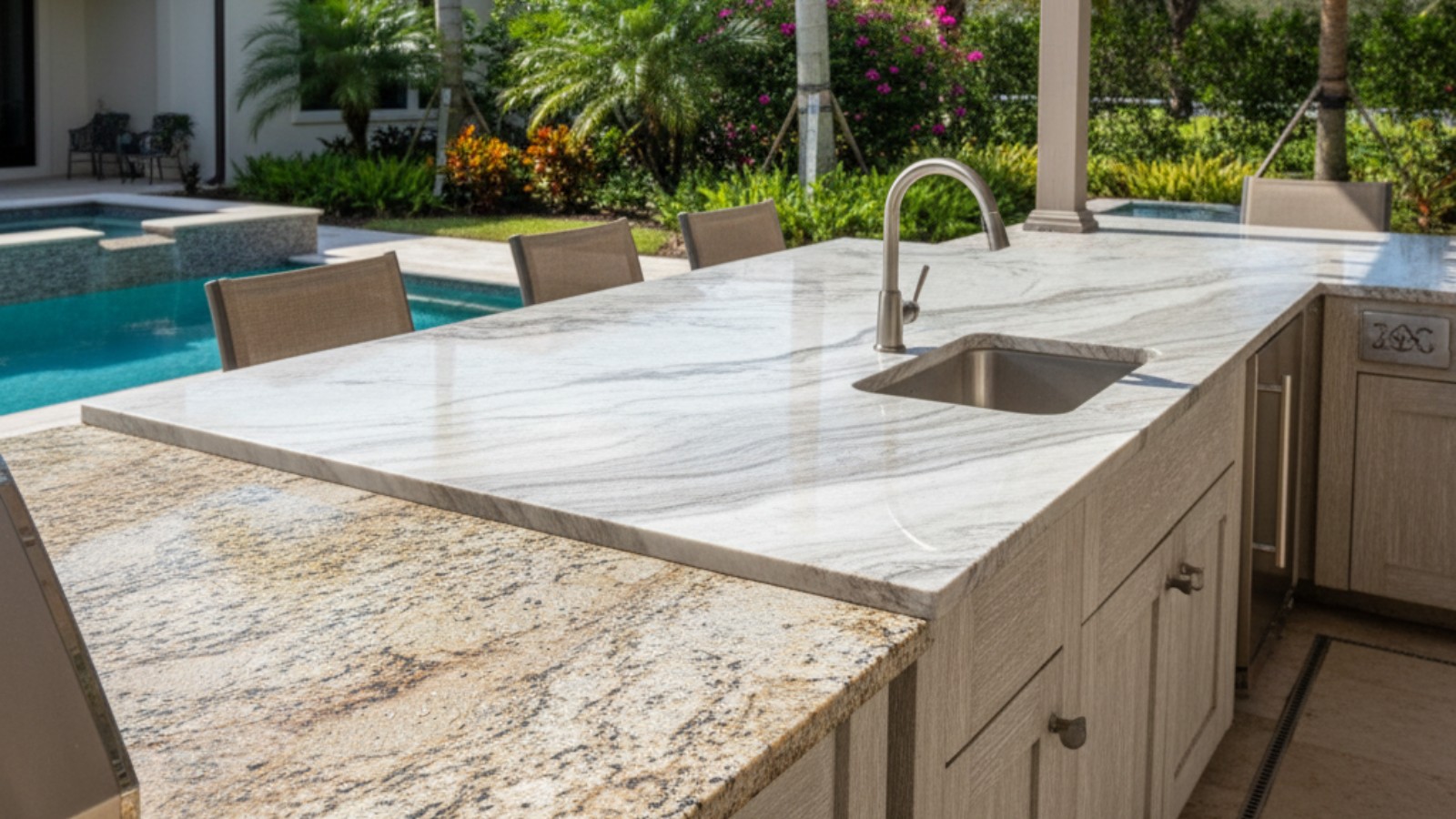
Best Countertop Materials for Outdoor Kitchens in Southwest Florida
Choosing an outdoor countertop in Southwest Florida requires more than comparing colors. See how granite, quartzite, and quartz differ around sun exposure, heat, moisture, maintenance, and manufacturer restrictions.
Choosing an outdoor kitchen countertop in Southwest Florida starts with one important distinction: a surface that works well indoors is not automatically suitable outside.
If you are comparing materials currently offered by HB Marble & Granite, granite is a strong starting point because natural granite has a long record of exterior use and weathering durability. Quartzite can also be considered, but its absorption, finish, and maintenance needs should be evaluated for the actual slab. Engineered quartz requires a product-specific answer. Some manufacturers exclude exterior installations from their warranties, while others manufacture specific outdoor-rated surfaces.
The right choice depends on where the kitchen sits, how much sun and rain reach it, how the grill area is designed, and how much maintenance you want to take on.
Why Outdoor Countertops Need a Different Material Decision
An indoor kitchen lives in a relatively controlled environment.
An outdoor kitchen can be exposed to direct sun, wind-driven rain, changing temperatures, cooking heat, food spills, and moisture throughout the year.
The amount of exposure can also change dramatically from one project to another.
A grill counter inside a deeply covered lanai does not face the same conditions as an island that receives several hours of direct sun and rain. That difference should be discussed before the slab is approved.
HB has documented a real outdoor kitchen project in Southwest Florida in an open-air, shaded lanai setting. It is a useful example of why the actual environment needs to be part of the material conversation.
See the project context in Real HB Projects.
Is Granite a Good Material for an Outdoor Kitchen?
Granite is one of the most established natural stones for exterior applications.
The Natural Stone Institute notes granite's strength, abrasion resistance, and weathering durability, which have supported its use in exterior applications for many years.
For an outdoor kitchen, those properties make granite a practical material to evaluate.
Granite also handles normal cooking-area heat well. Direct concentrated heat is still worth avoiding because strong temperature differences within natural stone can place stress on the material.
Learn more about the material in our Granite Guide.
Does Outdoor Granite Need to Be Sealed?
There is no universal schedule that applies to every granite slab.
Natural stone varies in absorption. Some granite is already highly moisture resistant, while other slabs may benefit from an impregnating sealer that provides additional resistance to stains.
A sealer does not make stone completely stain-proof.
For an outdoor kitchen, the specific slab, finish, exposure, and cooking habits should guide the recommendation.
This is more useful than automatically telling every homeowner to reseal on the same six-month or annual schedule.
What About Quartzite Outdoors?
Quartzite is another natural-stone option HB works with.
It is valued for its hardness and the natural movement found in individual slabs. That can make it especially attractive when the outdoor island is intended to become a major visual feature of the space.
The important point is that "quartzite" describes a category of natural stone, not one standardized product.
Porosity, mineral composition, finish, natural fissures, and absorption can vary.
For that reason, exterior suitability and maintenance should be discussed around the actual slab instead of relying on a blanket statement about every quartzite.
Explore the material further in our Quartzite Guide.
Does Quartzite Need Sealing?
Some quartzites can benefit from an impregnating sealer, while the needs of another slab may be different.
The Natural Stone Institute recommends understanding the actual stone before deciding whether sealing is necessary. Sealers increase stain resistance but do not make natural stone stain-proof.
In an outdoor cooking area, oils, sauces, drinks, and other spills make that conversation especially relevant.
The fabricator should help determine what is appropriate for the selected slab and finish.
Can You Use Quartz in an Outdoor Kitchen?
This is where product specifications matter most.
Engineered quartz should not be treated as one universal outdoor material.
For example, Cambria's current residential warranty applies to properly fabricated interior applications and specifically excludes outdoor and partially exposed outdoor installations.
At the same time, exterior-rated engineered products exist. Caesarstone currently offers an Outdoor Collection designed and tested for weather and UV resistance.
The practical rule is simple:
Do not approve engineered quartz for an outdoor kitchen based only on the word "quartz."
Check the exact manufacturer, product line, exterior-use documentation, and current warranty before fabrication.
Read more about engineered surfaces in our Quartz Guide.
Covered Does Not Automatically Mean Approved
A roof or lanai can reduce direct exposure, but it does not automatically change a manufacturer's warranty.
Some products may still classify a covered exterior kitchen as an outdoor or partially exposed installation.
The manufacturer's current documentation should make that decision, not an assumption based on how much shade the countertop receives.
How Does Florida Sun Affect the Decision?
Sun exposure should be documented before choosing the countertop.
Ask where the surface sits during the strongest part of the day. One section of an outdoor kitchen may remain shaded while another receives direct sunlight for hours.
This matters particularly with engineered products because exterior and UV approval can vary by manufacturer and product line.
Natural stone does not use the resin binders found in engineered quartz, but that does not eliminate the need to evaluate the actual stone, finish, and installation.
Color also affects the experience of the space.
A very dark countertop in direct Florida sun can become uncomfortable to touch even when the material itself remains suitable for exterior use.
What About Rain and Moisture?
Rain does not affect every countertop material in the same way.
For natural stone, absorption varies by the individual material.
That makes statements such as "all outdoor stone must be sealed every year" too broad.
The better approach is to identify the material, review its absorption and finish, and determine whether an impregnating treatment adds useful stain resistance.
Outdoor installation details matter as well. Water should not be allowed to collect because of poor layout or installation around the surrounding components.
The countertop is only one part of the outdoor kitchen system.
Which Material Handles Cooking Heat Best?
Outdoor cooking areas introduce heat from grills, side burners, pizza ovens, and countertop appliances.
Granite has strong documented heat resistance, although placing concentrated heat directly against any stone surface is unnecessary when simple protection can be used.
Quartzite is also a natural stone, but its exact properties should be evaluated with the selected slab.
Engineered quartz requires closer attention to manufacturer instructions. Resin-containing surfaces can have specific heat limitations even when a particular product is approved for exterior use.
The appliance itself also matters.
Grill manufacturers define clearances and installation requirements that should be incorporated into the countertop layout before fabrication.
Stains Matter More Around a Grill
Outdoor kitchens are working kitchens.
Cooking oils, marinades, wine, citrus, sauces, and grease can reach the countertop regularly.
For natural stone, stain resistance depends partly on the characteristics of the selected slab and whether an appropriate impregnating treatment is used.
Cleaning spills promptly remains important even when a surface has been treated.
Engineered products have their own care instructions. If an exterior-approved quartz product is selected, follow that manufacturer's cleaning guidance instead of applying natural-stone sealer or maintenance advice to it.
Should Marble Be Used for an Outdoor Kitchen?
HB also works with marble, but it deserves a different discussion around an active cooking surface.
Marble is a calcareous natural stone. Acids such as lemon and vinegar can react with calcium carbonate and etch the surface.
That does not mean marble can never be used outside.
It means a homeowner choosing marble around food preparation should understand that the surface can develop visible changes from normal use.
For someone whose priority is a forgiving grill and preparation counter, granite or an appropriate quartzite may deserve consideration first.
Learn more in our Marble Guide.
Installation Can Change How the Material Performs
Choosing the right slab is only part of an outdoor countertop project.
The installation also needs to account for support, seams, overhangs, appliance cutouts, and the conditions around the countertop.
A large grill opening changes the slab geometry. A long island may require seams or additional support. A waterfall edge increases the amount of material and requires another fabrication decision.
Appliances should be selected early enough for the fabricator to work from the correct specifications.
Natural Stone Institute countertop standards specifically include guidance for outdoor kitchen applications, which is another reason an exterior project should be planned as an exterior installation from the beginning.
Start With the Exposure, Then Choose the Material
There is no useful universal ranking that fits every Southwest Florida outdoor kitchen.
For someone who wants natural stone and a straightforward exterior track record, granite is a logical material to evaluate first.
Quartzite may fit a homeowner who wants more pronounced natural movement, provided the actual slab is appropriate for the application and its maintenance needs are understood.
Engineered quartz requires the most product-specific verification. Use it outside only when the exact product is documented for that environment and the intended installation fits the manufacturer's current requirements.
The project conditions should make the decision.
Compare Outdoor Kitchen Materials in Fort Myers
HB Marble & Granite fabricates and installs countertop surfaces for outdoor spaces across Southwest Florida and has documented outdoor work in its real-project gallery.
If you are planning a new outdoor kitchen, bring the layout, approximate dimensions, appliance information, and photos of the space when discussing the project.
You can compare available material directions on our Stone Colors page and see completed work in Real HB Projects.
For a project-specific recommendation, contact HB Marble & Granite or visit the Fort Myers showroom to review slabs and discuss how much exposure your outdoor kitchen will receive.
Enjoyed this article?
Share it with someone who might find it useful.