
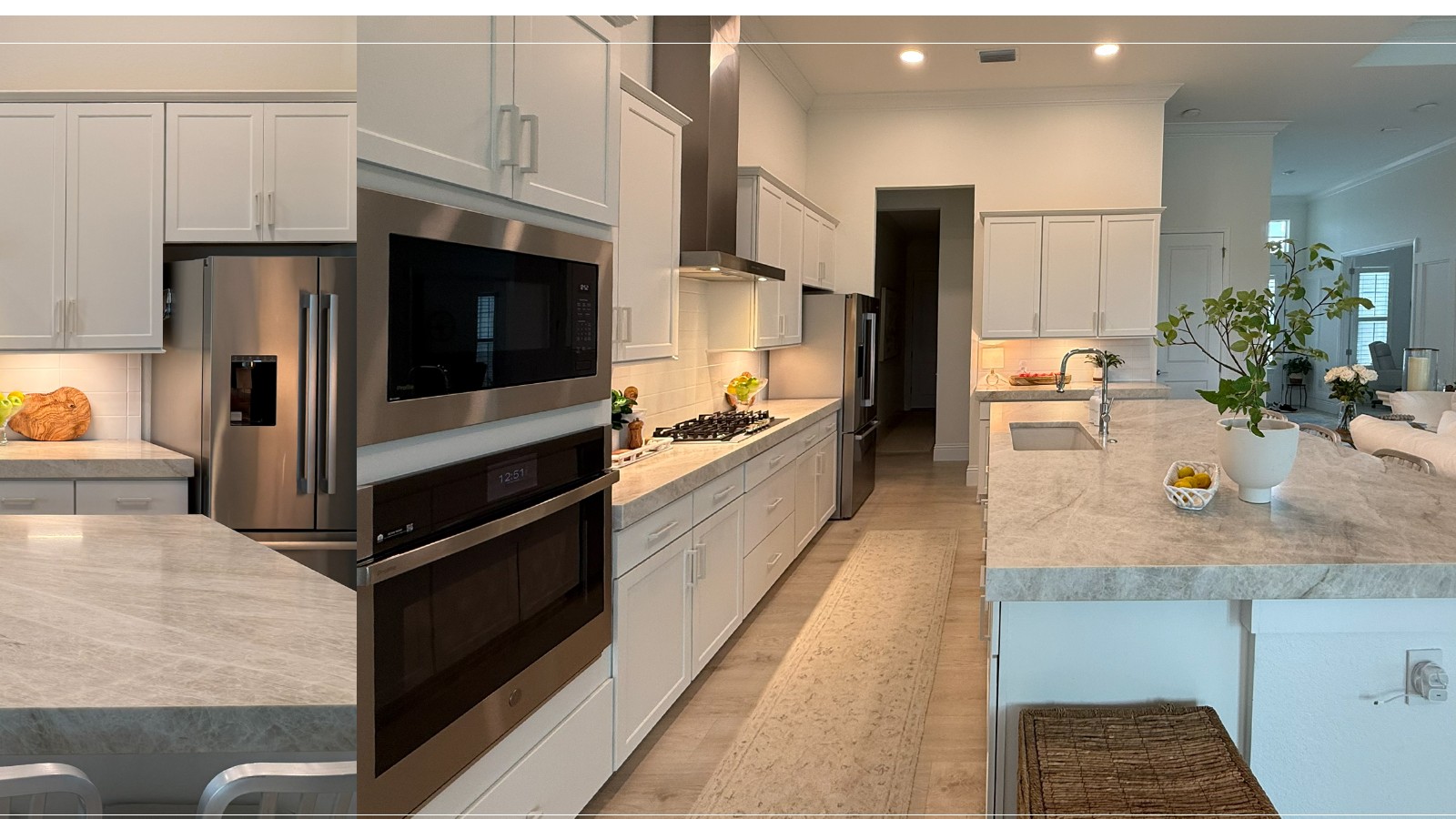
Granite vs. Quartz for Southwest Florida Kitchens: Heat, Stains, Care and Style
Granite and quartz can both work well in Southwest Florida kitchens, but they behave differently around heat, stains, maintenance, and design. Compare the differences before choosing your countertop.
Granite and quartz can both be strong choices for a Southwest Florida kitchen, but they fit different priorities.
Granite is natural stone, so every slab has its own color and movement. It handles normal kitchen heat well, although direct concentrated heat should still be avoided. Quartz is an engineered surface with more controlled patterns, a nonporous surface, and no routine sealing requirement. High heat requires more caution, and manufacturers recommend using trivets or hot pads.
The better choice depends on how you cook, how much maintenance you want, and what you want the finished kitchen to look like.
Granite and Quartz Are Different Types of Countertop
Granite is quarried from the earth and cut into slabs.
Its color, mineral pattern, and movement are created naturally, which means no two slabs are exactly alike. Even pieces from the same stone can show noticeable variation.
Quartz countertops are engineered surfaces made from mineral content combined with pigments and binders. Their designs are manufactured, so the pattern and color are generally more controlled than natural granite.
That distinction influences more than appearance. It affects heat behavior, sealing, stain resistance, and the way homeowners should evaluate the material before fabrication.
Learn more about natural stone in our Granite Guide or review engineered surfaces in our Quartz Guide.
Which Handles Heat Better?
Heat is one of the clearest differences between granite and quartz.
Granite and Kitchen Heat
Granite performs well around normal kitchen heat.
As a natural stone, it can tolerate temperatures that would be a greater concern for many engineered surfaces. That does not mean countertops should be used as permanent resting places for hot cookware.
Concentrated heat or sudden temperature changes can still create stress in natural stone, particularly near edges or other vulnerable areas.
Using a trivet remains a sensible habit, even with granite.
Quartz Requires More Heat Protection
Quartz manufacturers are more explicit about direct heat.
The resins used in engineered quartz can be affected by prolonged or concentrated heat. Manufacturers commonly recommend placing trivets or hot pads beneath hot pans and heat-producing appliances.
This also applies to appliances such as slow cookers, electric skillets, countertop ovens, and air fryers when they generate sustained heat.
For a household that frequently moves cookware directly from the stove or oven, this difference is worth considering before choosing the material.
What About Stains?
Both surfaces can perform well around everyday spills, but they achieve that resistance differently.
Quartz Is Nonporous
Quartz surfaces from major manufacturers are nonporous.
Liquids do not absorb into the surface in the same way they can with some natural stones, and routine sealing is not required.
That makes quartz appealing to homeowners who want straightforward daily maintenance.
Stain resistant does not mean impossible to damage. Strong chemicals, inappropriate cleaners, and prolonged contact with certain substances can still affect a quartz surface.
Always follow the care instructions for the specific manufacturer installed in your kitchen.
Granite Varies by Stone
Granite does not have one universal absorption rate.
Some granite varieties absorb very little moisture and may not need additional sealing. Other stones can benefit from an impregnating sealer that increases resistance to staining.
A sealer also does not make granite completely stain-proof.
The actual slab should determine the maintenance recommendation instead of assuming that every granite countertop needs to be sealed on the same schedule.
Which One Is Easier to Maintain?
For homeowners who want to minimize routine maintenance, quartz has a clear practical advantage.
It does not normally require sealing. Daily care usually involves a soft cloth, warm water, and an appropriate mild cleaner.
Granite care is also straightforward, but the stone itself should be evaluated to determine whether sealing is useful.
The key difference is that quartz offers a more standardized maintenance expectation, while granite maintenance can depend on the individual stone.
Neither material benefits from aggressive cleaning chemicals simply because the surface is durable.
How Do Granite and Quartz Compare in Style?
This decision often becomes much easier once homeowners see full slabs.
Granite Has Natural Variation
Granite works well when the homeowner wants the countertop to look distinctly natural.
Mineral deposits, color shifts, and movement vary from slab to slab. A sample can show the general character of the stone, but it cannot show exactly how a full kitchen will look.
For large islands, seeing the actual slab before fabrication can be especially useful.
The portion selected for the island may have stronger movement than the pieces used around the perimeter.
Quartz Offers More Control
Quartz is useful when consistency is a priority.
Its pattern is designed rather than formed naturally, which makes samples more representative of the finished surface.
That can make it easier to coordinate the countertops with cabinets, flooring, backsplash, and other finishes.
There can still be variation between lots and designs, so the actual product should always be reviewed before ordering.
See current options on the Stone Colors page.
What Works Better for a Large Kitchen Island?
Both materials can work well on a large island.
The difference is what you want the island to do visually.
Granite can turn the island into a unique focal point because the natural movement of the slab becomes a major part of the design. The slab layout should be planned carefully so the strongest areas of the stone appear where they make sense.
Quartz can create a more controlled result across a large surface. This may be useful when the cabinets, lighting, or backsplash already carry a lot of visual detail.
The dimensions of the island also matter.
Slab size, seams, overhangs, sink or cooktop placement, and pattern direction should all be reviewed before fabrication begins.
Which Material Fits a Busy Family Kitchen?
Daily habits matter more than broad labels such as "best countertop."
If the kitchen regularly sees hot cookware and the homeowner prefers natural variation, granite may fit those priorities well.
If easy cleanup, no routine sealing, and consistent design matter more, quartz may be a better match.
A household that cooks heavily may evaluate heat differently from someone who mostly uses the kitchen for lighter meal preparation.
That is why the material should be selected around actual use rather than appearance alone.
What About Chips and Scratches?
Both granite and quartz are durable countertop materials, but neither is indestructible.
Hard impacts around exposed edges can damage either surface.
Granite is naturally hard and generally performs well against normal kitchen wear. Quartz is also highly resistant to everyday scratches and chips, although manufacturers still recommend using cutting boards rather than cutting directly on the countertop.
Durability should not be interpreted as permission to ignore basic care.
The location of seams, sink openings, cooktops, and exposed corners can also affect how a countertop performs over time.
Does Southwest Florida Change the Decision?
For an indoor kitchen, being in Southwest Florida does not fundamentally change the physical properties of granite or quartz.
The local advantage comes from being able to evaluate the materials and project requirements in person.
HB Marble & Granite offers granite and quartz fabrication and installation from its Fort Myers operation and serves homeowners throughout Southwest Florida.
Seeing full slabs and samples at the showroom can help homeowners compare natural variation against a more consistent engineered surface before fabrication begins.
This is especially useful when the project includes a large island or when cabinet and flooring selections have already been made.
What If the Kitchen Extends Outdoors?
An outdoor kitchen is a different decision.
Granite has a long history of exterior use, while standard engineered quartz should not automatically be assumed to be suitable outdoors.
Some quartz manufacturers offer products specifically approved for exterior applications, while other quartz warranties exclude outdoor installation.
If part of the project will be outside or exposed to significant sunlight, tell the fabricator before selecting the material.
The exact product specifications should be reviewed before fabrication.
Granite May Fit Better If...
Granite can make sense when natural variation is an important part of the design and the homeowner wants a surface with strong heat performance.
It is also a good material to consider when seeing and selecting the individual slab is part of the experience.
Maintenance should be based on the specific stone rather than a universal sealing schedule.
Quartz May Fit Better If...
Quartz can make sense when the homeowner values predictable color, straightforward cleaning, and a surface that does not require routine sealing.
It is particularly practical when consistency across several countertop runs is important.
The main behavioral adjustment is heat protection. Hot pans and heat-producing appliances should be kept off the surface with a suitable barrier.
Questions to Ask Before Choosing
Before making the final decision, think about how the kitchen will actually be used.
Consider how often hot cookware is moved around, how comfortable you are with occasional stone maintenance, and whether you prefer natural variation or a more controlled appearance.
If the kitchen has a large island, look at full slabs instead of relying only on small samples.
Also ask how seams, edge profiles, sink cutouts, and backsplash choices will work with the material you are considering.
The right countertop is the one that fits those project details and your expectations for daily use.
Compare Granite and Quartz in Fort Myers
The differences between granite and quartz become much easier to understand when you see the materials side by side.
HB Marble & Granite fabricates and installs both granite and quartz countertops for kitchens in Fort Myers and across Southwest Florida.
Visit the Fort Myers showroom to compare colors, patterns, and material characteristics in person. You can also view completed work in our Project Gallery and Real Projects.
When you are ready to discuss your kitchen, contact HB Marble & Granite to compare materials with the team and plan the next steps for your project.
Enjoyed this article?
Share it with someone who might find it useful.